
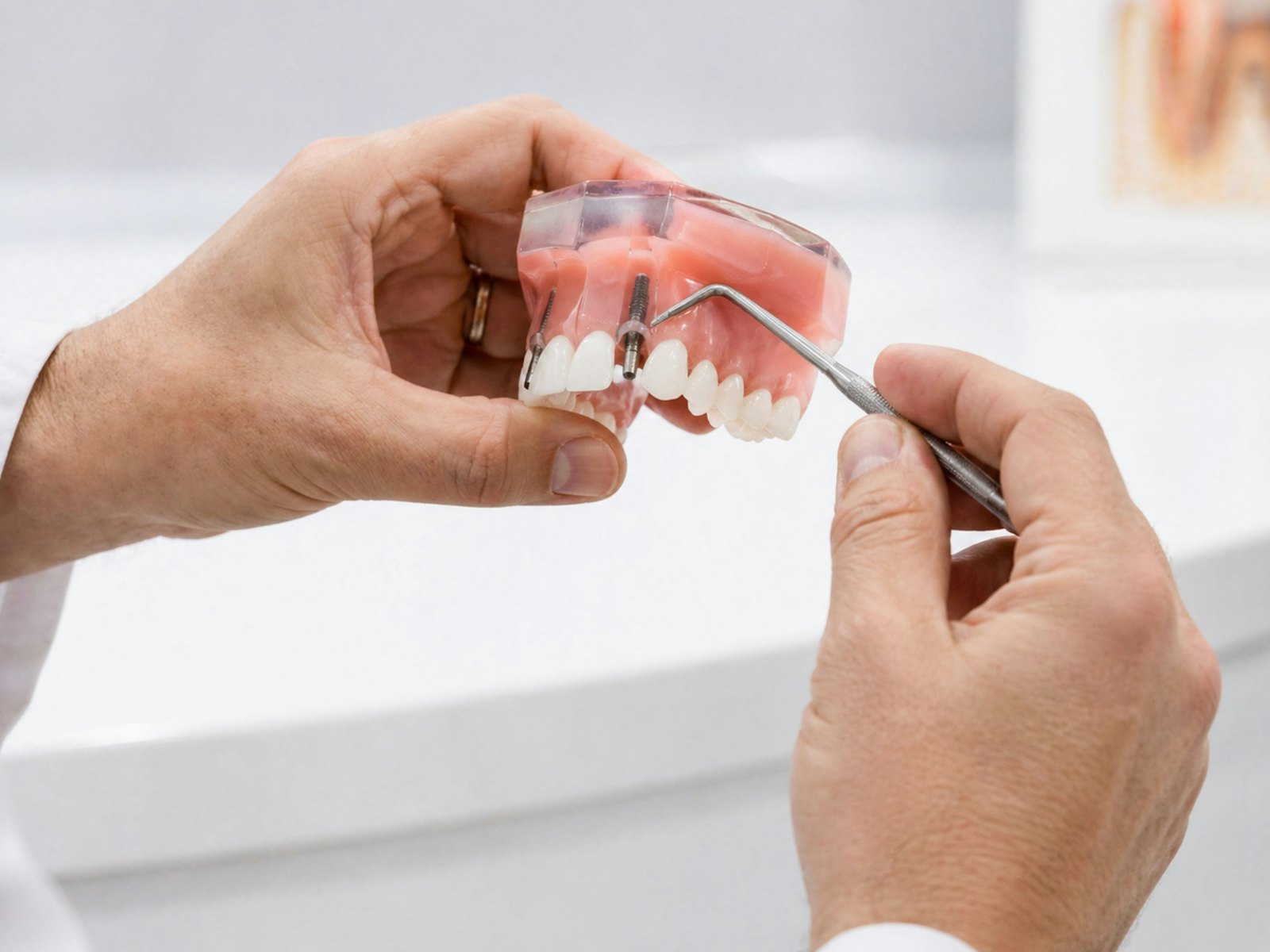
Guided implant surgery is no longer a single technique. Clinicians can choose a pilot-guided protocol, where the guide controls only the first drill, or a fully guided protocol, where the guide controls every drill and often the implant insertion itself. Both approaches are legitimate. The difficulty is knowing which one a particular case actually needs.
This article breaks down the practical differences, the trade-offs each approach carries, and a simple framework for deciding case by case.
What Pilot-Guided Surgery Means
In a pilot-guided protocol, the surgical guide holds the initial drill, usually a narrow twist drill, on the planned position, angle, and depth. Once the pilot osteotomy is complete, the guide comes out and the clinician finishes the preparation freehand with the standard drill sequence.
The appeal is simplicity. Pilot guides work with almost any implant system, do not require a dedicated guided surgical kit, and leave plenty of room for the handpiece. They are often used when interarch space is limited or when the clinician wants to keep tactile feedback during the later drills.
The limitation is that only the first drill is controlled. Every freehand drill that follows can drift slightly, especially in dense bone, soft bone, or sites with sloping crests. The final implant position depends heavily on operator skill after the guide is removed.
What Fully Guided Surgery Means
A fully guided protocol keeps the guide in place for the entire drill sequence. Each drill passes through the sleeve, often with drill keys or stops that control diameter and depth. In many systems the implant is also delivered through the guide, so position, angle, depth, and sometimes rotational orientation of the connection are all controlled.
This approach transfers more of the digital plan directly into the patient. It is especially valuable when the restoration has been designed in detail ahead of time, for example when a provisional prosthesis will be delivered on the day of surgery. For a closer look at how each protocol works in practice, the overview of pilot vs fully guided surgical guides lays out the mechanics side by side.
The trade-offs are real, though. Fully guided protocols need a compatible guided kit, more vertical space, and careful attention to irrigation because the guide covers more of the site. They also reduce tactile feedback, which some clinicians find uncomfortable at first.
Comparing the Two Approaches
When the two protocols are compared on the factors that matter most to clinicians, the differences become clear:
- Control of final position: Fully guided protocols control the whole sequence. Pilot protocols control only the starting point and trajectory.
- Space requirements: Pilot guides need less vertical room. Fully guided setups need room for longer drills plus the sleeve and handpiece.
- Kit requirements: Pilot guides work with standard drills. Fully guided surgery needs a system-specific guided kit.
- Learning curve: Pilot protocols feel familiar to clinicians used to freehand surgery. Fully guided protocols take a few cases to become comfortable.
- Immediate restoration: When a prosthesis will be delivered the same day, fully guided placement makes it easier to match the plan.
Cases That Favor Pilot Guidance
Pilot guidance is often a sensible choice in a few situations. Single posterior implants in patients with limited mouth opening are a classic example, since the reduced drill stack makes access easier. Straightforward sites with good bone volume, where the main goal is a correct starting point and angle, also suit pilot guides well.
Pilot guides can also be a practical first step for teams moving from freehand to guided surgery. They introduce digital planning and guide handling without requiring a new surgical kit on day one.
Cases That Favor Full Guidance
Full guidance tends to earn its place when the margin for error is small. Sites close to the inferior alveolar nerve, the mental foramen, or the sinus floor benefit from controlled depth on every drill. Multiple adjacent implants that must be parallel for a bridge are another strong indication, as small freehand deviations can add up across the span.
Full-arch cases, particularly those with immediate loading, often depend on fully guided placement so the prefabricated provisional fits the implants as planned. Esthetic anterior sites, where a small angulation change can affect the emergence profile and the final smile, are also good candidates.
A Simple Decision Framework
Instead of choosing one protocol for every case, many clinicians use a short checklist during planning:
- How close is the planned implant to a critical structure?
- Is there enough interarch space for a fully guided drill stack at this site?
- Will the restoration be delivered immediately, and how precise must the implant position be for it to fit?
- Are multiple implants involved that must be parallel or evenly spaced?
- Does the clinician have a guided kit compatible with the chosen implant system?
If the answers point toward tight tolerances, critical anatomy, or immediate restoration, full guidance is usually the better fit. If access is limited and the site is straightforward, pilot guidance can deliver a reliable result with less complexity.
Why the Plan Matters More Than the Protocol
Neither protocol rescues a weak plan. The implant position should be driven by the planned restoration, the scans should be clean and accurately merged, and the guide should seat firmly on its support surface. When those foundations are in place, either protocol can perform well within its limits.
Communication with the design team is equally important. Telling the lab which implant system, which guided kit, and which protocol you intend to use allows the sleeves, offsets, and drill lengths to be designed correctly. Many surgery-day surprises trace back to a missing detail at the ordering stage.
Making the Choice With Confidence
Pilot and fully guided surgery are not competing philosophies. They are tools suited to different clinical conditions. Clinicians who understand the strengths of each can choose deliberately rather than by habit, and that usually translates into more predictable outcomes for patients.
If you are planning upcoming cases and want help deciding which protocol suits each site, a case-based design review with an experienced surgical guide for dental implants provider can clarify the options before anything is printed. The right protocol, matched to a solid plan, gives the surgery its best chance of going exactly as intended.