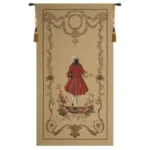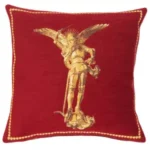
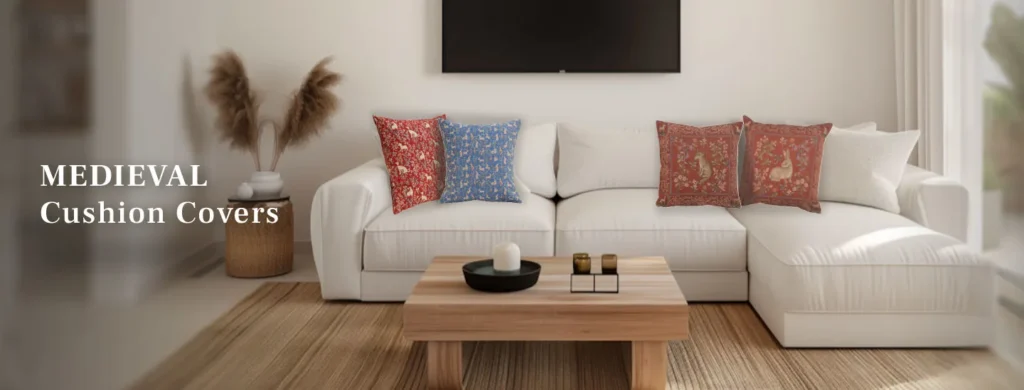

When people think of tapestry in interior design, they most often picture wall hangings — large woven panels that dominate a room from above. But the tapestry tradition has always extended to soft furnishings as well, and medieval cushion covers offer one of the most accessible and versatile ways to bring the richness of woven textile art into your home. Whether you’re looking to complement an existing tapestry wall hanging, add texture and historical character to a sofa or armchair, or simply introduce a touch of medieval craft into a contemporary setting, tapestry cushion covers in medieval designs deliver remarkable visual impact for their size.
What Makes a Cushion Cover “Medieval”?
The term “medieval” in the context of tapestry cushion covers refers primarily to design vocabulary: imagery drawn from the visual language of 12th–15th century European art and craft. This includes heraldic motifs — shields, crests, lions, eagles, and fleur-de-lis — as well as hunting scenes, millefleurs compositions, architectural fragments such as Gothic arches and tracery, mythological creatures including dragons and griffins, and courtly life imagery such as knights, ladies, and tournaments. The colour palettes of medieval tapestry art — deep burgundy, forest green, gold, navy, and ivory — are characteristic, though contemporary weavers have expanded these considerably. The defining quality is a sense of pictorial richness and symbolic depth that connects the viewer to a rich cultural heritage.
How Medieval Cushion Covers Work in Modern Interiors
One of the most appealing qualities of medieval tapestry cushion covers is their surprising versatility across decorating styles. In traditional or period interiors — Georgian, Victorian, Arts and Crafts, or country-house — they feel entirely at home. But they also work remarkably well in more contemporary settings. A pair of heraldic tapestry cushions on a plain grey linen sofa, or a single medieval hunt scene cushion on a leather armchair, adds a note of cultural depth and visual richness that lifts the whole room. The key is using them as deliberate accent pieces rather than trying to match them too closely to everything else in the room: tapestry cushions are character pieces that benefit from a degree of visual contrast with their surroundings.
Combining Multiple Covers
One of the pleasures of collecting tapestry cushion covers is building a grouping of complementary pieces. You might assemble three or four covers in related colour families but different designs — a heraldic lion, a millefleurs panel, and a hunting scene in burgundy and gold, for example — for a sofa arrangement that feels curated and cohesive without being uniform. Alternatively, two matching covers flanking a central plain cushion in a complementary solid colour creates a formally balanced arrangement suited to more structured interior schemes. The most important principle is that the covers should share at least one common element — colour family, general period, or stylistic character — to create a sense of intentionality rather than randomness. For a wide range of designs and colourways, the collection of medieval cushion covers provides excellent inspiration and variety.
Quality and Construction
Quality medieval tapestry cushion covers are woven on Jacquard looms using wool, cotton, or wool-cotton blends, with the design fully integrated into the weave structure rather than printed onto the surface. This distinction matters enormously for both appearance and longevity: a genuinely woven cover has the characteristic texture and depth of tapestry art, with colour variations that arise from the interlacing of different threads rather than from a printed ink layer. The back panel is typically plain cotton or linen, and good-quality covers will have a concealed zip or button closure that allows the insert to be changed easily. Fill your medieval covers with duck feather cushion pads for the best combination of comfort and shape-holding.
Care and Maintenance
Tapestry cushion covers are more robust than they might appear but benefit from sensible care. Most can be hand-washed in cool water with a gentle detergent and laid flat to dry — always check the specific washing instructions for your cover before proceeding. Avoid tumble drying, which can cause shrinkage and colour run. Light brushing removes surface dust between washes, and the covers benefit from occasional rotation to ensure even wear. Kept away from direct prolonged sunlight, quality tapestry covers will maintain their colour and weave integrity for many years of daily use.
Where to Find the Best Medieval Cushion Covers
The best sources for medieval tapestry cushion covers are those that prioritise genuine woven quality and authentic design inspiration. For a curated selection spanning heraldic, millefleurs, hunting, and courtly life themes across a range of sizes and colourways, the collection of medieval tapestry pillow cases and cushion covers at Charlotte Home Furnishings offers a carefully assembled range that brings genuine medieval design heritage into everyday domestic use.