
Among the greatest treasures of medieval art, the Lady and the Unicorn tapestries hold a uniquely powerful place. Woven in the late 15th century, these six magnificent panels — now housed in the Musée de Cluny in Paris — are among the finest surviving examples of the millefleurs style of tapestry weaving, and their mysterious imagery has captivated scholars, poets, and art lovers for over five centuries. For anyone drawn to tapestry as a form of interior art, understanding these legendary pieces opens a window into the symbolic language that made European woven textiles so much more than decoration.
Origins and History
The Lady and the Unicorn tapestries were produced in the workshops of Flanders — most likely in Brussels — between approximately 1484 and 1500, commissioned by Jean Le Viste, a nobleman of Lyon. They were woven in wool and silk on a linen warp, using the sophisticated technique of the Flemish ateliers at the height of their powers. The six panels were discovered in the 19th century in Boussac Castle in the Creuse region of France, in a state of some deterioration, and were subsequently acquired by the Musée de Cluny, where they have been displayed ever since — most recently in a purpose-built gallery designed to showcase them under ideal conditions.
The Six Panels and Their Symbolism
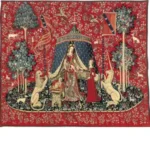
Five of the six panels are widely understood to represent the five senses: sight, hearing, taste, smell, and touch. In each, a nobly dressed lady is accompanied by a lion and a unicorn — the heraldic animals of the Le Viste family — along with an array of symbolic flora and fauna in the characteristic millefleurs style. The sixth panel, bearing the inscription “À Mon Seul Désir” (To My Sole Desire), is the most enigmatic: the lady is shown placing a necklace into a jewellery box, and scholars have debated for generations whether this panel represents a sixth sense, the soul, the rejection of worldly desire, or something else entirely. This mystery is a significant part of the tapestries’ enduring fascination.
The Millefleurs Background
One of the most distinctive features of the Lady and the Unicorn series is the deep crimson-red background scattered with hundreds of individually rendered flowering plants and animals — the millefleurs (thousand flowers) style. This lush, slightly otherworldly setting lifts the figures out of any specific place or time and into a realm of pure symbol and dream. The plants depicted — roses, sweet briar, holly, carnations, marigolds — are rendered with botanical accuracy alongside rabbits, birds, monkeys, and dogs, creating a visual richness that rewards extended contemplation.
Why Lady and Unicorn Tapestries Remain So Popular
The Lady and the Unicorn series has influenced textile design across the centuries, and its imagery remains among the most recognisable and sought-after in the tapestry world. Reproductions and interpretations of the original panels — as well as original designs in the same spirit — are consistently among the most popular tapestry choices for home interiors. The combination of the noble female figure, the mythical unicorn, the heraldic lion, and the millefleurs background creates a visual composition of extraordinary richness and grace that works beautifully in a wide range of interior styles, from traditional to eclectic contemporary. For those drawn to this iconic tradition, there is a wonderful selection of lady and unicorn tapestries available that bring this heritage into modern living spaces with skill and authenticity.
The Unicorn as Symbol
The unicorn in medieval iconography carried profound symbolic weight. Associated with purity, grace, and the untameable wild, the unicorn was believed in medieval bestiaries to be capturable only by a virgin — hence its recurring association with noble ladies in tapestry art. In heraldry, it represented power, independence, and virtue. In the Lady and the Unicorn panels, the unicorn serves both as a heraldic emblem of the Le Viste family and as a richly layered symbolic presence that amplifies the themes of each composition. This dual role — decorative and deeply meaningful — is characteristic of the best medieval tapestry art, where beauty and significance are inseparable.
Bringing This Legacy Home
The enduring appeal of the Lady and Unicorn tradition lies in its ability to transform any room into a space of genuine cultural depth and visual beauty. Whether you choose a faithful reproduction of one of the original Cluny panels or a contemporary design inspired by their spirit, these woven lady and unicorn wall tapestries carry centuries of artistic tradition into your home — a remarkable achievement for any decorative object.