
Islamic wall tapestries have adorned homes, mosques, and palaces for centuries. Today, they remain one of the most expressive and meaningful ways to decorate a living space — combining breathtaking artistic craftsmanship with deep spiritual resonance. Whether you’re furnishing a Muslim household or simply drawn to the extraordinary beauty of Islamic geometric and calligraphic art, a well-chosen tapestry transforms any room.
The Two Great Traditions: Calligraphy and Geometry
Islamic tapestries fall broadly into two artistic traditions, each with its own distinct visual character and spiritual significance.
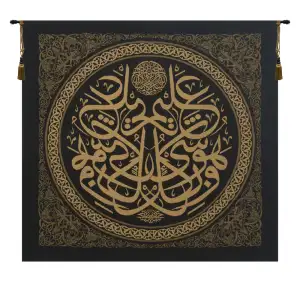
Calligraphic tapestries reproduce sacred text — verses from the Holy Quran, the ninety-nine names of Allah, prayers, and phrases of remembrance — in the world’s most sophisticated tradition of decorative writing. Arabic calligraphy developed not merely as a system of communication but as the highest of all Islamic arts, capable of conveying the beauty and power of sacred language through visual form. Calligraphic tapestries in homes serve as constant reminders of faith, creating a spiritually charged atmosphere that prayer beads or candles alone cannot provide.
Geometric tapestries draw on the mathematical genius of Islamic civilization. The intricate star polygons, interlocking hexagons, and spiraling arabesques that adorn the great mosques of Cordoba, Istanbul, and Isfahan have been woven into textiles for centuries. These patterns, often based on principles of symmetry and proportion drawn from Islamic scholarship in mathematics and astronomy, have a visual complexity that rewards sustained attention — and a calming, meditative quality when displayed in the home.
Choosing the Right Style for Your Space
The choice between calligraphic and geometric Islamic tapestries depends largely on the intended purpose and the space’s existing character.
For spaces used for prayer or religious reflection, a calligraphic tapestry bearing Ayat al-Kursi (the Throne Verse), Surah Al-Fatiha, or the Shahada creates a meaningful focal point. The combination of text and textile art reflects the Quranic instruction that homes should be filled with the remembrance of Allah.
For living rooms, dining rooms, and hallways, geometric tapestries offer striking visual impact without the specific religious weight of calligraphic pieces. Their bold, intricate patterns work exceptionally well as statement wall art, commanding attention the way a great painting would.
For a comprehensive collection covering both traditions, browse the full range of Islamic tapestries at Charlotte Home Furnishings.
Color and Composition
Traditional Islamic tapestries favor rich jewel tones — lapis lazuli blue, deep emerald, burgundy, and gold — that echo the tile work, mosaic, and painted ceilings of historical Islamic architecture. These colors work beautifully in rooms with warm wood tones, Persian carpets, and brass or copper accents.
Contemporary interpretations offer more restrained palettes — cream, ivory, and gold on white; graphite geometric patterns on natural linen — that suit minimalist or Scandinavian-influenced interiors while maintaining the geometric or calligraphic heritage.
Pairing and Grouping
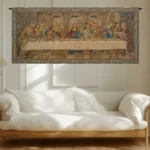
A single large tapestry bearing a Quranic verse makes a powerful solo statement above a sofa, mantelpiece, or hallway console. For a gallery wall arrangement, combine a central calligraphic tapestry flanked by two smaller geometric pieces in complementary colors.
Mixing scales adds visual interest: a large geometric tapestry anchors the arrangement while smaller calligraphic panels on either side introduce the textual dimension.
Styling and Display
Islamic tapestries look best mounted on a properly sized rod with matching decorative brackets. Brass or antique gold hardware complements traditional designs; matte black or natural wood suits contemporary pieces. Ensure the tapestry hangs flat and taut with no buckles or folds across the face.
Explore the full collection of authentic Islamic wall tapestries to find the perfect piece for your home, from grand calligraphic displays to intricate geometric patterns in a range of sizes and colourways.