
Islamic tapestries represent one of the most beautiful and spiritually meaningful forms of textile art in the world. Rooted in centuries of artistic tradition, they combine intricate geometric patterns, flowing arabesque designs, and the powerful beauty of Quranic calligraphy into wall hangings that bring both faith and refinement to any space. For Muslim households and those who appreciate Islamic art and culture, these tapestries offer a way to fill a home with meaning, history, and elegance.
The Art of Islamic Textile Design
Islamic decorative art has a rich history spanning more than fourteen centuries. Governed by the principle that figurative representation in religious contexts should be avoided, Islamic artists developed extraordinarily sophisticated non-figurative traditions — geometric abstraction, arabesque plant motifs, and above all, the art of calligraphy.
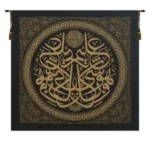
Calligraphic tapestries reproduce verses from the Quran, the names of Allah and the Prophet Muhammad (peace be upon him), or classic phrases such as Bismillah ir-Rahman ir-Rahim in styles ranging from classical Kufic script to the flowing elegance of Naskh or Thuluth. The result is a wall hanging that functions as both art and a constant reminder of faith.
Geometric and Arabesque Tapestries
Beyond calligraphy, Islamic geometric art offers another remarkable tradition for textile interpretation. Intricate interlocking star patterns, hexagonal grids, and elaborate multi-pointed rosettes — drawn from the mathematical and astronomical scholarship of the Islamic golden age — translate extraordinarily well into woven form. The repetitive nature of geometric patterns suits the grid structure of woven textiles, and the resulting tapestries have a meditative, ordered beauty.
Arabesque tapestries, featuring stylized scrolling vines and floral motifs, offer a softer alternative with the same deep cultural roots. They suit living spaces, hallways, and bedrooms where a flowing, organic quality is desired.
Where to Display Islamic Tapestries
Islamic calligraphy tapestries are traditionally displayed in positions of prominence and respect — the main living area, the entrance hall, or dedicated prayer rooms. A Quranic verse tapestry positioned at eye level on the qibla wall (the wall facing Mecca) creates a beautiful focal point for prayer.
In bedrooms, a tapestry bearing the names of Allah or protective verses such as Ayat al-Kursi is both decorative and spiritually significant. In dining rooms, geometric or arabesque tapestries bring visual warmth and cultural richness to the space.
Choosing the Right Piece
When choosing an Islamic tapestry, consider both the visual composition and the text or motif featured. A large tapestry bearing Surah Al-Fatiha suits a formal reception room; a smaller piece with the Shahada is appropriate for a personal prayer space. Geometric designs in jewel tones — deep blues, golds, and rich burgundy — evoke the tile work of great mosques and suit traditional or richly decorated interiors, while simpler designs in cream and gold suit contemporary spaces.
Explore the full selection of Islamic tapestries at Charlotte Home Furnishings to find pieces combining authentic artistic traditions with beautiful craftsmanship.
Care and Display
Islamic calligraphy tapestries should be handled and displayed with care and respect. Hang them away from direct sunlight to preserve the vibrancy of dyes. Use a proper tapestry rod system to distribute weight evenly and prevent stress on the textile. Dust gently with a soft brush rather than vacuuming directly on the face of the tapestry.
These pieces are not simply home décor — they are expressions of faith and cultural heritage. Treating them with the care appropriate to their significance ensures they remain beautiful and meaningful for generations.
For a curated range of high-quality Islamic tapestries for the home, browse the full collection available in a variety of sizes, styles, and calligraphic traditions.