
Religious tapestries occupy a uniquely meaningful place in home decoration. Unlike purely aesthetic wall art, a religious tapestry carries devotional significance that goes beyond visual pleasure — it invites contemplation, expresses faith, and connects the domestic space to a wider tradition of sacred art that stretches back centuries. Choosing the right piece requires balancing artistic quality, theological resonance, and practical considerations of scale and placement. This guide walks through the key factors to consider.
Define Your Purpose
The first question to ask when choosing a religious tapestry is: what is it for? If the primary purpose is devotional — a focal point for prayer, a visual expression of personal faith, or a votive object hung in thanksgiving — then theological accuracy and iconographic richness matter most. Choose a design whose imagery you find genuinely spiritually resonant, and ensure that the iconography is doctrinally appropriate to your tradition. If the purpose is primarily aesthetic — bringing the visual language of sacred art into your home for its beauty and cultural depth — then compositional quality and colour harmony take precedence over precise theological considerations, and you may be drawn to imagery from multiple religious traditions or historical periods.
Understanding Religious Tapestry Iconography
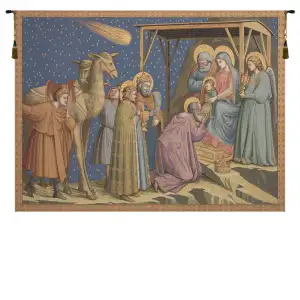
Christian religious tapestries typically draw on two broad iconographic traditions. The first is narrative: scenes from the Life of Christ, the Life of the Virgin, the Acts of the Apostles, or the Lives of the Saints, rendered with the pictorial richness of medieval and Renaissance devotional painting. The second is symbolic: compositions built around sacred symbols — the Cross, the Chi-Rho monogram, the Alpha and Omega, the dove of the Holy Spirit, the fish — that communicate faith through visual sign rather than narrative story. Narrative tapestries reward extended, reflective viewing; symbolic compositions have a more immediate, meditative quality. Consider which approach better suits both your personal spiritual practice and the room in which the tapestry will hang.
Scale and Room Selection
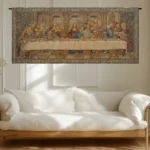
Religious tapestries work well in a variety of domestic settings. A large narrative scene — the Nativity, the Last Supper, the Annunciation — suits a dining room or formal sitting room where it can function as a genuine devotional focal point and conversation piece. Smaller pieces — a Madonna and Child, a Cross in a millefleurs surround, a single saint — work well in bedrooms, studies, or personal prayer corners. For a dedicated prayer or meditation space, a tapestry of moderate size at eye level when seated creates the ideal devotional focal point. Whatever the setting, ensure the tapestry has adequate visual space around it: religious imagery benefits from a certain dignity of display, and should not be crowded by competing artworks or cluttered surroundings.
Quality Considerations
Religious tapestries vary widely in quality, and for a piece intended for devotional display, quality matters particularly. A finely woven tapestry with carefully graduated colour, well-defined figures, and a coherent compositional design honours the subject matter in a way that a cheaply produced piece does not. Look for genuine Jacquard-woven construction in wool or cotton, with borders that form an integral part of the weave rather than being applied separately. The best religious tapestries are those that give visual pleasure each time you look at them — revealing new details, nuances of colour, and relationships between figures that reward sustained attention. For a selection that combines quality weaving with spiritually resonant imagery, the collection of religious wall tapestries offers a carefully curated range of options.
Placement and Hanging
A religious tapestry deserves a position of honour in the room. The traditional placement for devotional imagery is at or slightly above eye level when standing — high enough to inspire an upward glance, but not so high as to feel remote or inaccessible. In a bedroom used for personal prayer, position the tapestry so that it is visible from wherever you pray — whether standing, kneeling, or seated. Ensure adequate lighting: religious tapestries, especially those with rich colour and fine detail, look their best under warm incandescent or halogen light, which brings out the warmth of the threads and deepens the shadows within the composition. Avoid harsh cool LED lighting, which can make warm-toned tapestries look flat and dull.
A Living Tradition
The tradition of religious tapestry art is one of the longest and most culturally significant in the history of European decorative art. Bringing a quality religious tapestry into your home connects you to that tradition in a direct and meaningful way — placing in your daily life an object that honours both the craft of the weaver and the depth of the faith it expresses. For all the designs discussed above, the complete selection of sacred and religious wall tapestries at Charlotte Home Furnishings provides a thoughtful starting point for this important decorating decision.