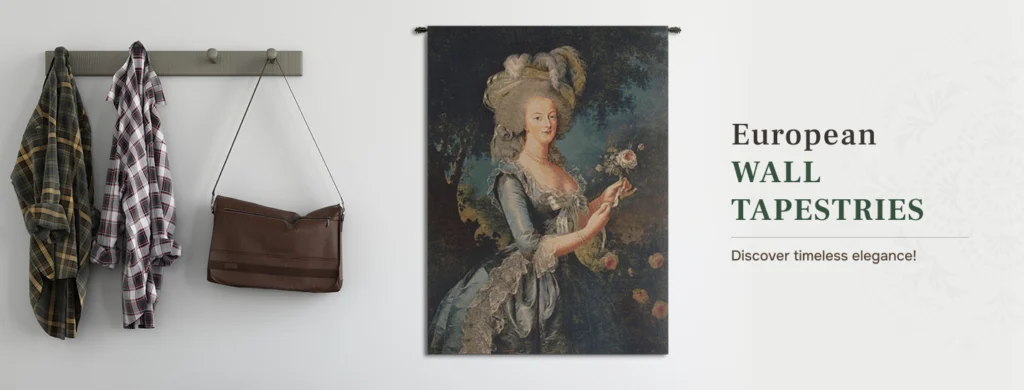

Some walls simply demand more than a framed print or a cluster of small artworks. A large, blank wall in a hallway, above a sofa, or at the end of a dining room presents both a challenge and an opportunity: the chance to introduce a genuinely commanding focal point that defines the entire space. Large tapestries are one of the most effective — and historically rich — solutions to this design challenge, bringing together scale, texture, colour, and narrative in a way that no other wall treatment can quite replicate.
Why Large Tapestries Work So Well
The visual impact of a large tapestry is fundamentally different from that of a large framed painting or canvas print. Where a painting has a flat, reflective surface, a tapestry has physical texture — the warp and weft of its threads create a surface that catches and diffuses light, producing a sense of warmth and depth that shifts depending on the angle of illumination. In rooms with natural light, a tapestry appears to glow softly; in the evening, under warm artificial lighting, it takes on a richer, more jewel-like quality. This responsiveness to light is one of the qualities that has made tapestries prized wall coverings for centuries, from medieval castle halls to grand Victorian drawing rooms.
Scale and Room Proportion
A large tapestry — typically over 120cm in width, with many examples ranging from 150cm to well over 200cm — can transform the apparent scale of a room. In a tall-ceilinged space, a large tapestry fills vertical space in a way that feels architectural rather than merely decorative. In a long, narrow hallway, a wide tapestry on the end wall creates a visual terminus that draws the eye and makes the space feel intentional rather than transitional. Even in a modestly sized room, a well-chosen large tapestry can act as a “room anchor” — a single dominant element around which all other furniture and decoration is oriented.
Classic Themes for Large Tapestries
The most celebrated large tapestry themes are those developed in the great weaving centres of medieval Flanders and France — scenes that were designed precisely to fill the broad walls of great halls and reception rooms. Hunting tapestries, depicting stag hunts, falconry, and woodland pursuits, were among the most popular: their horizontal compositions spread naturally across wide walls, and their dense detail rewards sustained viewing. Millefleurs tapestries — featuring meadows alive with flowering plants and animals against dark or richly coloured grounds — offer a different visual character: more intimate in detail but equally impressive at scale. For the full range of large format woven designs available, explore the collection of large tapestries for walls, where pieces are available in sizes suited to ambitious interior schemes.
Colour and Interior Harmony
Choosing a large tapestry requires careful attention to colour, since at scale, a tapestry’s dominant hues will significantly influence the overall tone of the room. Deep greens, burgundies, and gold ochres — characteristic of classic Flemish and French tapestries — work beautifully in rooms furnished with warm wood tones, leather, and natural textiles. Cooler blue-grey tapestries suit more contemporary interiors with stone floors, pale walls, and metal accents. A common mistake is choosing a tapestry whose colours fight with existing furnishings; the better approach is to select a tapestry first, as the dominant statement piece, and build the room’s palette around it.
Display Considerations for Large Pieces
Hanging a large tapestry requires some preparation. The most traditional method uses a wooden rod inserted through a woven sleeve along the top of the tapestry, supported by brackets at each end. For very large and heavy pieces, a continuous support batten — a flat timber length attached to the wall — distributes the weight more evenly and prevents sagging. Ensure the wall fixings are anchored into studs or masonry rather than plasterboard alone; a large tapestry can be surprisingly heavy. Hanging it absolutely square is important aesthetically: use a level and take time to adjust the rod or batten before making it permanent.
The Investment Value of Large Tapestries
A quality large tapestry is a genuine long-term investment in your home’s character. Unlike fashion-driven wall art that dates quickly, the classic designs of European tapestry weaving have maintained their appeal for centuries and show no signs of going out of style. A well-cared-for tapestry — kept out of direct sunlight, dusted regularly, and stored rolled if ever removed — will outlast virtually any other form of decorative wall art. For those ready to commit to a genuinely distinctive focal piece, the finest oversized woven wall tapestries offer an unmatched combination of artistic heritage, visual drama, and lasting quality.